


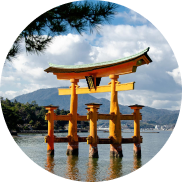
Torii
Perhaps one of the most famous symbols of Shintoism are the majestic portals that mark the entrance to shrines. Made of wood, metal, stone or cement, the double-pillared portals are called "torii" and demarcate the division between secular space and the area inhabited by a kami. The act of passing through a torii is seen as a form of purification, which is very important when visiting a shrine.
In Japan, the color red represents the sun and life and is also said to ward off bad omens and disasters. By crossing a torii, visitors are cleansed of any bad energy, ensuring that only good energy is brought to the kami who resides there.
There are a variety of toriis made from unlacquered wood, stone (usually white or gray) and even metal. Although there are a large number of color variations, there are an even larger number of shapes (somewhere around 60). The two most common types, however, are "myojin" and "shinmei". Myojin torii are curved upwards at their ends and have a beam that extends beyond the pilasters. Shinmei torii have a straight top and a crosspiece that ends at each pilaster.
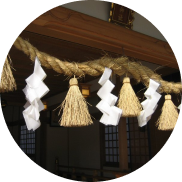
Shimenawa
Shimenawa are rice fiber ropes often adorned with white paper strips in the shape of a zig-zag (resembling thunder) and natural tassels. They are often seen hanging from toriis, tied around tree trunks, rocks or even tied around the waists of sumo wrestlers. Usually in sets of three, they are known as "yorishiro", meaning something that attracts gods or has a god living inside it. The shimenawa is usually used to demarcate the boundaries of sacred space, warding off evil spirits.
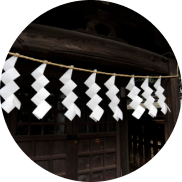
Shide
These are the white zig-zag papers, often hung from the shimenawa, sacred rope. These items are often used to separate the secular world from the sacred world. The thunder-shaped decorations are called "shide" (pronounced "she-day") and are also used in a variety of purification ceremonies.
There are two theories that try to decipher why the shide is shaped like lightning. One claims that the shape is representative of the infinite power of the gods and the other suggests that, like rain and clouds, thunder is an element of a good harvest. The lightning-shaped shadow is a prayer to the gods for a season of abundance.
There are a variety of different shide-adorned wands used in Shinto, with subtle differences between them in terms of style. Two of these wands are called "gohei" and "haraegushi." The "miko", women who work in shrines, use the gohei wand with two shides attached in rituals and ceremonies to bless people, but the main purpose of the wand is to bless objects or purify sacred objects.
The haraegushi wand, with many shields attached, is used for cleansing purposes, but under different circumstances. A Shinto priest rhythmically waves the haraegushi over a person or objects recently obtained by a person, such as a new house or car, to perform this purification ritual.
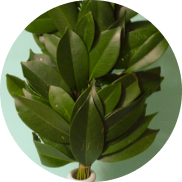
Sakaki
As nature worship is a key element of Shintoism, trees play an important role. Certain types are considered sacred and are known as "shinboku". Not unlike toriis, these trees that surround a shrine create a sacred space that is considered purified. Although there are a few types of trees that are considered sacred, there is perhaps none more important than the sakaki, an evergreen species native to Japan.
Sakaki trees are commonly planted around shrines to act as a sacred fence. Often a branch of sakaki is used as an offering to the gods. One of the reasons why sakaki trees are considered sacred by Shinto has to do with the fact that they are evergreen and therefore symbols of immortality. Another important reason is associated with a legend that a sakaki tree was decorated to lure Amaterasu, the sun goddess, out of her hiding place in a cave.
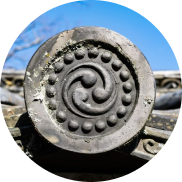
Tomoe
The swirling "tomoe" symbol may remind you of the well-known yin-yang symbol from China. However, the meaning and use are quite different. Tomoe, often translated as "comma", was commonly used on Japanese badges of authority called "mon", and as such, tomoe is associated with the samurai.
The tomoe can have two, three or even four commas in its design. The three-comma "mitsu-domoe", however, is the most commonly used in Shinto and represents the interaction of the three realms of existence: heaven, earth and the underworld.
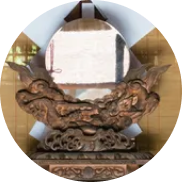
Shinkyo
The Shinkyo or "god's mirror" is a mystical object that connects our world to the spiritual realm. The Shinkyo can be displayed on Shinto altars as an avatar of the kami: the idea is that the god will enter the mirror to interact with our world.
This belief dates back to a legend involving the Japanese sun goddess, Amaterasu, who once hid in a cave, plunging the world into darkness. In order to persuade her to leave the cave, several gods gathered outside the cave and held a party. The gods hung jewels and a mirror on a sakaki tree in front of the cave to distract Amaterasu's attention if she ventured outside. Curious about the festive noises, Amaterasu peeked out of the cave and asked why the gods were celebrating. In response, she was told that there was a goddess even more beautiful than her outside the cave. On leaving, the goddess was greeted by her own reflection in the mirror, at which point the other gods took the opportunity to close and seal the cave with a shimenawa.
This same mirror was later given to Amaterasu's grandson with instructions to worship it as if it were Amaterasu herself. In this way, one doesn't necessarily pray to a shinkyo, but rather to the god of that shrine for whom the mirror is acting as a physical avatar. The shinkyo is considered a "shintai", a physical substitute that the kami can inhabit in the human realm. The cave described in the legend is actually a real place, called Amanoyasugawara Shrine, in Miyazaki Prefecture, Japan.
Shinto
In Shinto, it is often said that "man is the son of kami". Firstly, this means that people are given life by kami and that their nature is therefore sacred. Secondly, it means that daily life is made possible by the kami and therefore people's personalities and lives are worthy of respect. Individuals should revere the basic human rights of all (regardless of race, nationality and other distinctions), as well as their own.
Shinto literally means kami-no-michi or "the way of the kami" (in a literal translation, the divine or sacred power). The spiritual philosophy of Shinto came into use to distinguish native Japanese beliefs from those of Buddhism, which had been introduced to Japan in the 6th century AD. Shinto has no founder, no official sacred texts or scriptures, and no fixed dogmas, but it has preserved its guiding beliefs throughout the ages.
The biblical concept of original sin is not found in Shinto. On the contrary, humanity is considered to have a primarily divine nature. In reality, however, this sacred nature is rarely revealed in human beings. Purification is considered, symbolically, to remove the confusion and uncertainties that populate people's minds. We understand that the definition of Shinto as the "Way of the Gods" is incomplete. The way of the kami, of sacred energies and manifestations, makes more sense to us.
We create pieces that aim to help you find one of the many paths of Shinto. And you'll soon understand that our creations are not eternal, and even less so as adornments. They are an instrument for us to reflect on what is inside us, our behavior and the way we think. When the natural fibers of your piece fall apart, you will understand that what matters is not the talisman, but the willpower you put into it to follow the path of good.
Nature and Variety
Shinto is found mainly in Japan, where there are around 80,000 public shrines, although practitioners are also scattered around the world. The connection between the kami and the natural world has led Shintoism to be considered animistic.
The belief cultivates harmony between humans and kami (always asking for the latter's blessing). Shintoism has a strong conceptual focus on ensuring purity, mainly through cleansing practices such as ritual washing and bathing, especially before worship. Little emphasis is placed on specific moral codes or particular beliefs about the afterlife, although the dead are considered capable of becoming kami.
The veneration of the kami dates back to Japan's Yayoi period (300 BC to 300 AD), although it has been suggested that the concept may be older than that. Buddhism entered Japan at the end of the Kofun period (300 to 538 BC) and spread rapidly. Religious syncretism made kami worship and Buddhism functionally inseparable, in a process called shinbutsu-shūgō. The kami came to be seen as part of Buddhist cosmology and were increasingly represented anthropomorphically.
In the following centuries, shinbutsu-shūgō was adopted by Japan's imperial family. During the Meiji era (1868 to 1912), Japan's nationalist leadership expelled the Buddhist influence of kami worship and formed the Shinto State, which some historians consider to be the origin of Shinto as a distinct religion. Shrines came under increasing government influence and citizens were encouraged to worship the Emperor as a kami. With the formation of the Japanese Empire in the early 20th century, Shinto was exported to other areas of East Asia. After Japan's defeat in the Second World War, Shinto was formally separated from the state.